UX/UI Redesign
E- learning
UX/UI

Making learning feel rewarding and consistent
This project explored how gamification can improve engagement in e-learning platforms. By analyzing gaps in learner motivation, I redesigned key learning interactions using reward systems, streak tracking, and progress feedback to encourage consistent learning behavior.
My Role
UX Designer — Evaluation to Interface
Evaluated the learning experience, identified engagement gaps, and designed gamified features with structured flows and high-fidelity mobile UI to improve learner motivation and course consistency.
Team
Academic Individual Project
Independently planned, designed, and documented the project as part of an academic UX study focusing on engagement and motivation in digital learning.
UX Evaluation & Engagement Design
I performed a feature walkthrough of the app by observing how users browse courses, watch lessons, and track progress. Based on identified friction points, I translated behavioral insights into design opportunities.


No reward or feedback after completing lessons
Learning feels passive and one-directional
No habit-forming mechanism to return daily
Progress tracking lacks motivation
Missing reminders or accountability
The platform supports learning content but not learning behavior.
Many learners enroll in online courses with initial interest but struggle to continue consistently. The learning experience mainly supports watching videos, while lacking feedback, rewards, and progress satisfaction that encourage regular participation. Without motivational cues or reminders, learners gradually lose engagement, leading to incomplete courses and irregular learning habits.
Encourage learners to return regularly by introducing habit-forming interactions that make daily learning feel guided and purposeful rather than optional.
Increase course completion by providing clear progress visibility and continuous feedback so learners can understand how far they have come and what remains.
Improve motivation during lessons by rewarding participation and acknowledging effort, helping users feel a sense of achievement after each learning session.
Transform passive video watching into an interactive experience by adding engagement elements that keep learners attentive and involved throughout the course journey.
Encourage learners to return regularly by introducing habit-forming interactions that make daily learning feel guided and purposeful rather than optional.
Increase course completion by providing clear progress visibility and continuous feedback so learners can understand how far they have come and what remains.
Improve motivation during lessons by rewarding participation and acknowledging effort, helping users feel a sense of achievement after each learning session.
Transform passive video watching into an interactive experience by adding engagement elements that keep learners attentive and involved throughout the course journey.
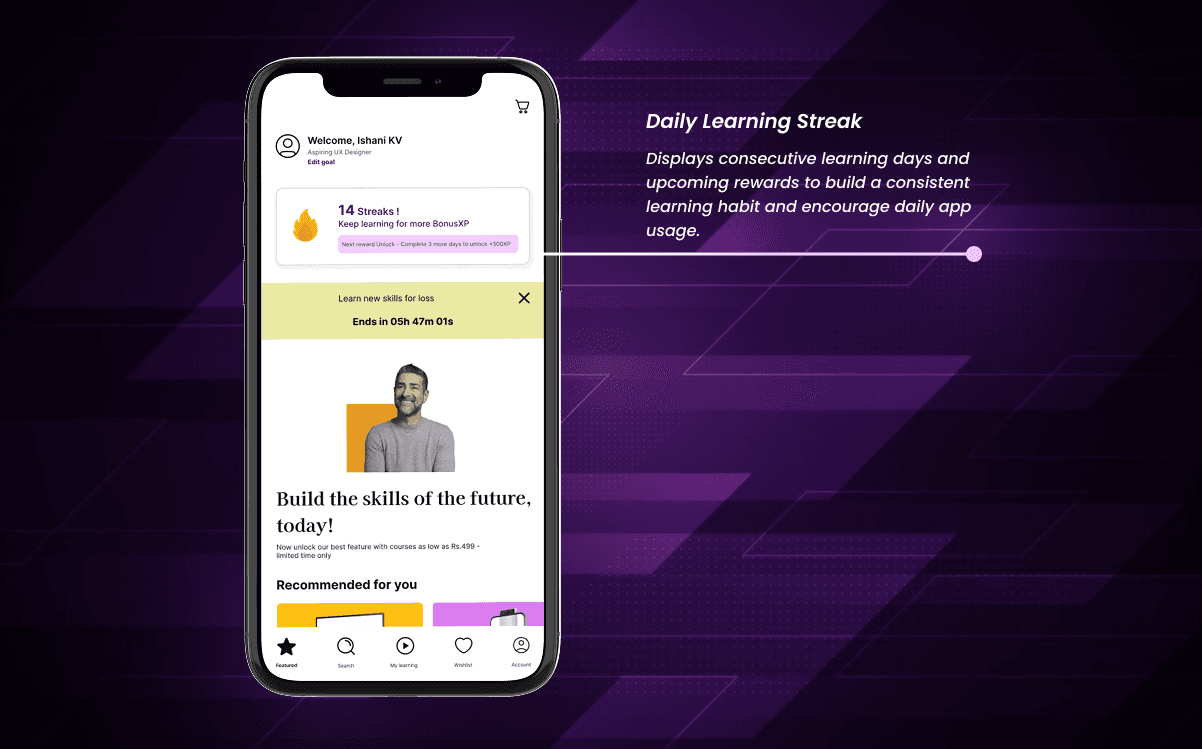
Daily Streak Habit System
A consistency-based learning habit tracker encouraging users to return daily.
Streak begins after 2 consecutive learning days
Milestone rewards at 3, 7, 14, 30 days
Streak freeze prevents penalty for one missed day
Dashboard shows next reward milestone
Why I designed this :
Users drop courses due to lack of routine.
Streaks transform learning into a daily habit instead of a one-time activity.
Design Goal :
Increase retention and reduce procrastination.
XP-Based Progression System
A structured reward model where learners earn XP for completing videos, quizzes, and learning activities.
+50 XP for completing a lesson video
+100 XP for quizzes/assignments
+20 XP bonus for daily consistency
Level-up unlocks badges, certificates, and rewards
Why I designed this :
Learners often consume content passively.
XP converts watching into achievement-driven progress, giving users visible learning advancement.
Design Goal :
Create a sense of accomplishment and motivate course completion.